
Quick answer
Recover the solvent. Concentrate the contamination.
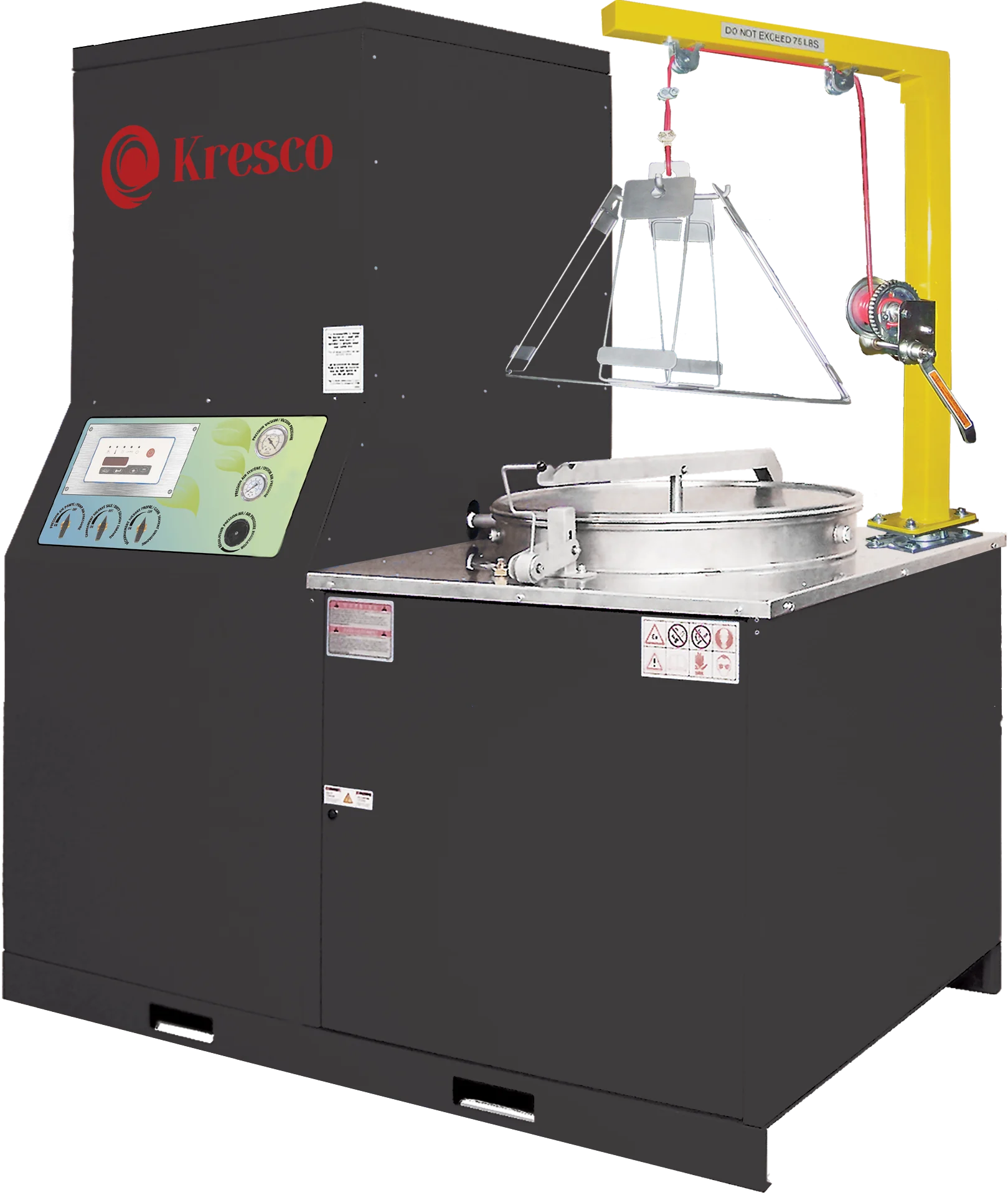
A solvent recycler is a still built to recover reusable solvent from a contaminated stream. It heats dirty solvent, sends solvent vapor through a condenser, and collects liquid distillate. Paint solids, resins, oils, pigments, and other higher-boiling contamination remain as still bottoms for proper disposal.
Load
Put a compatible dirty-solvent batch into the distillation vessel.
Heat
Indirect heat through thermal oil raises solvent into its controlled boiling range.
Condense
Vapor leaves less-volatile contamination and returns to liquid in the condenser.
Recover
Collect qualified solvent, cool the unit, and manage still bottoms correctly.
Distillation separates by volatility. It does not automatically remove every close-boiling solvent, water, dissolved contaminant, or additive. Test recovered quality against the reuse requirement.
Capacity
Size by gallons of dirty solvent per day.
Use measured waste generation—not solvent purchases—as the starting point.
- 01Record dirty-solvent gallons by day and week for a representative period.
- 02Separate streams that should not be mixed.
- 03Confirm usable batch fill, not only nominal vessel size.
- 04Divide daily dirty solvent by practical batches per day.
- 05Check cycle time, cooldown, residue removal, bag changes, and staffing.
- 06Add capacity for peak days, growth, maintenance, and downtime.
- 07Verify power, compressed air, floor space, loading, collection, and residue handling.
A small unit can process substantial weekly volume if cycles fit the shift. A large unit can still bottleneck if the solvent needs a long cycle or the shop cannot unload residue between batches.
Payback vs. hauling
Model the costs you stop—and the costs you add.
Annual value
- + Fresh solvent purchases displaced
- + Waste pickup, transport, and disposal avoided
- + Drum handling and administration reduced
Annual operating cost
- − Electricity and compressed air
- − Bags, thermal oil, seals, and maintenance
- − Labor and still-bottom disposal
Simple payback: installed project cost ÷ annual net savings. SRS reports that many customers achieve a 4–12 month return and that compatible streams can recover 97% or more. Treat those as possible supplier-reported outcomes—not guarantees. SRS solvent recycler overview
Solvent compatibility
A familiar solvent name is not a compatibility approval.
Send the current SDS, dirty-stream composition, contamination, and intended reuse. Water, close-boiling mixtures, reactive materials, and heat-sensitive solvents can require separation, vacuum, special controls, or a different process.
| Solvent stream | Common candidate | Verify |
|---|---|---|
| Mineral spirits | Parts cleaning, paint, and maintenance | Boiling range, water, oil loading, desired purity |
| Lacquer thinner | Wood finishing, cabinet shops, coatings | Blend composition, close-boiling components, resin and pigment |
| Acetone | Cleaning, coatings, composites | Flash point, water, contamination, equipment rating |
| MEK | Coatings, adhesives, industrial cleaning | Complete SDS, blend stability, vapor controls, reuse purity |
| IPA and alcohols | Printing, cleaning, process use | Water, azeotropes, desired concentration, configuration |
| Naphtha / paint thinner | Cleaning and finishing | Exact formulation, boiling curve, additives, contamination |
| Flexo and litho wash | Printing | Ink and resin loading, water, mixed-solvent composition |
| Paint-booth line flush | Coatings operations | Mixed solvents, solids loading, required reclaimed quality |
Consumables + service
Plan bags, heat-transfer oil, and service parts into operating cost.
Recycler bags
Approved high-temperature liners can capture sludge and simplify cleanout. Match size, thickness, temperature, and chemistry.
Heat-transfer oil
Thermal oil carries heater energy to the vessel. Use the specified fluid, maintain level, and replace it by condition and guidance.
Service items
Lid gaskets, seals, filters, sensors, condenser components, and cooling airflow affect cycle performance.
Safety + venting
Specify the unit for the complete solvent stream and location.
- Review every constituent and current SDS.
- Confirm hazardous-location certification and electrical requirements.
- Engineer room ventilation and vent or discharge routing for the actual solvent and local code.
- Provide grounding, bonding, spill control, compatible containers, and fire protection.
- Train operators on loading, limits, cooldown, residue removal, alarms, and shutdown.
- Review with the manufacturer, EHS team, insurer, officials, and authority having jurisdiction.
The SRS SR120 reference system is listed for Class I, Division I, Group D service and UL 2208. Do not assume every recycler or installation carries the same rating. SR120 specifications
Request for quote
Send the SDS, dirty gallons, contamination, and current costs.
- Current SDS for every solvent and blend
- Dirty gallons per day and week, plus peaks
- Source process and contamination
- Desired recovered quality and reuse
- Fresh-solvent price and annual purchases
- Waste drums, pickup frequency, and disposal cost
- Power, compressed air, floor space, and ventilation
- Hazardous-location and local EHS or fire requirements
- Loading, clean-solvent collection, and residue handling