
Quick answer
A heated, recirculating spray process for repeatable batches.
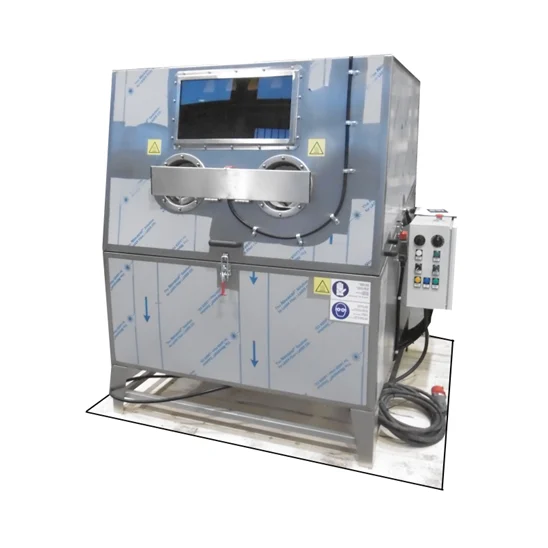
An aqueous jet-spray cabinet washer is an enclosed cleaning system. Parts sit on a rotating turntable while a pump sends heated water-based detergent through nozzles above, below, and around the load. The solution drains back to a tank for reuse. EPA aqueous-cleaning guidance
Load
Fixture parts with room for spray access, rotation, and drainage.
Heat
Bring the water and specified detergent into the process temperature range.
Spray
Pump solution through a fixed manifold while the turntable moves the load.
Manage
Capture chips and solids, remove free oil, then rinse or dry as required.
Cleaning performance comes from chemistry, heat, mechanical spray force, time, and coverage. More pressure is not automatically better.
Aqueous vs. solvent parts washer
Choose the process around the soil, part, and finish.
Aqueous often wins for automated batches, repeatable production, water-compatible parts, and mixed oil, grease, and particulate. Solvent often wins for quick manual work, water-sensitive components, and soils that dissolve better in a compatible solvent.
| Decision | Aqueous jet spray | Solvent washer |
|---|---|---|
| Cleaning mechanism | Heat, detergent, spray force, and time | Compatible soil dissolves into solvent |
| Best fit | Automated batches and mixed soils | Quick manual work and solvent-soluble soils |
| Drying | May need rinse, blow-off, heat, or time | Often evaporates quickly; residue depends on solvent |
| Corrosion | May require inhibitors and immediate drying | Lower flash-rust risk; compatibility still matters |
| Waste streams | Spent bath, sludge, filters, skimmed oil | Spent solvent, filters, VOCs, hazardous waste |
Do not assume aqueous waste is automatically nonhazardous. Classification depends on the cleaner and everything removed from the parts.
Industrial parts washer sizing
Size the working envelope—not the catalog label.
A part can fit the cabinet and still clean poorly if it blocks rotation, shields the spray, traps solution, or overloads one side of the turntable.
Part envelope
Measure the largest part in its cleaning orientation, including the rack, basket, or fixture.
Turntable diameter
Leave clearance for rotation, spray access, and drainage; nominal fit alone is not enough.
Working height
Check usable height with the door or lid fully closed and the part correctly fixtured.
Load capacity
Include baskets and fixtures, then verify load distribution—not just total weight.
Throughput
Define parts per batch, batches per shift, cycle target, and warm-up expectations.
Facility fit
Confirm opening path, lid-open height, power, drainage, ventilation, footprint, and service access.
Bath management
Heat and chemistry clean. Filtration and skimming keep the bath useful.
Heat
Select temperature around the chemistry, substrate, seals, soil, and cycle—not the heater’s maximum.
Detergent
Control concentration, pH, hardness, inhibitors, rinsing, and residue requirements for the downstream finish.
Filtration
Screens, chip baskets, filters, and sludge cleanout protect pumps and nozzles while extending solution life.
Oil skimming
A skimmer removes free-floating oil. It does not replace filtration, sludge removal, or bath control.
SRS equipment lines
Compare Build-All and Magido around the application.
Build-All
Build-All manufactures solvent and aqueous parts washing equipment in Milwaukee, Wisconsin. SRS supports the equipment with replacement parts, filtration, and chemicals.
Magido
Magido industrial jet-spray cabinets use rotating turntables and stainless wash systems in top-load and front-load configurations. Compare envelope, load, pump, heat, skimming, filtration, and loading.
Ultrasonic option
Use cavitation when critical surfaces hide from the spray.
Ultrasonic cleaning can reach fine features, bores, passages, blind holes, and complex geometry. It is not automatically a substitute for jet spray: large heavy parts, high soil loads, and production batches may still favor a spray cabinet, with ultrasonics used for precision parts or a second stage.
Request for quote
Send the part, soil, throughput, and cleanliness target.
- Part photos, dimensions, weight, material, and fixture
- Soil type and approximate loading
- Required cleanliness, residue, and downstream process
- Parts per batch and batches per shift
- Current method and what is not working
- Wash, rinse, blow-off, and drying stages
- Power, floor space, drainage, ventilation, and loading
- Specified chemistry, corrosion inhibitors, or wastewater limits