
Quick answer
Choose a room when the work—or the operator—cannot fit the cabinet.
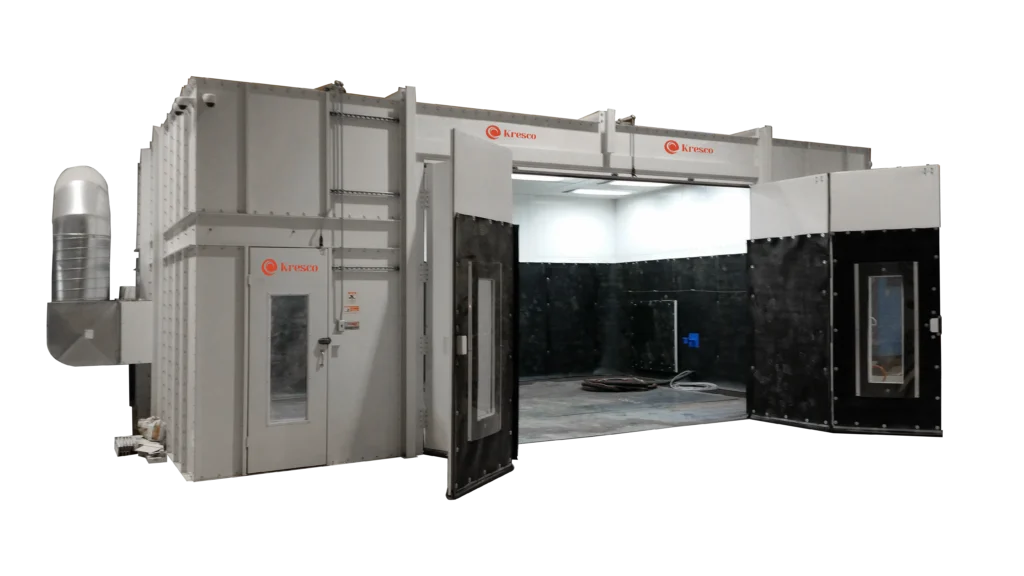
OSHA defines a blast-cleaning room as a complete enclosure where the operator works inside and directs the nozzle. A blast cabinet keeps the operator outside, reaching through openings. That distinction is the fastest way to frame the choice. OSHA 1910.94
Choose a room for trailers, weldments, machinery, long fabrications, or any work that requires walk-around access. Choose a cabinet when parts can be loaded through a door, manipulated from outside, and processed without entering the enclosure.
| Decision factor | Blast cabinet | Abrasive blast room |
|---|---|---|
| Operator position | Outside the enclosure | Inside the enclosure |
| Typical work | Small and medium parts | Large parts, assemblies, vehicles, long fabrications |
| Part handling | Hand load, cart, turntable, basket | Forklift, cart, rail, monorail, crane slot |
| Floor space | Compact | Room plus dust, recovery, controls, and service area |
| Recovery | Often integrated | Sweep-in, pneumatic, mechanical, or hybrid |
| Best fit | Repeatable parts that fit the chamber | Walk-around access or large material flow |
Blast room design
Size the production cell, not just the box.
A good blast room design accounts for people, material flow, recovery, air movement, and service access around the largest workpiece.
- 01
Measure the part in its blasting orientation
Include racks, fixtures, skids, carts, or rotators—not only the bare part.
- 02
Add working clearance
Allow room for stance, hose control, nozzle angle, and a clear path around the work.
- 03
Plan the opening
Door dimensions, crane slots, forklift approach, and rail alignment can set the room size.
- 04
Map material flow
Show where unfinished parts enter, clean parts exit, and blasting connects to coating.
- 05
Reserve support space
Dust collection, ductwork, recovery, controls, the blast pot, and service access sit outside.
- 06
Check the building
Confirm floor loading, pits, roof height, power, compressed air, make-up air, and permits.
Media recovery
Match recovery to media, labor, and uptime.
The right system depends on media density, breakdown rate, production hours, floor construction, cleanup labor, and how quickly abrasive must return to the blast pot. SRS offers pneumatic, mechanical, and hybrid recovery configurations matched to throughput.
Sweep-in / partial reclaim
Best for
Intermittent or lower-volume work; lower initial budget
Trade-off
More manual cleanup and more interruptions
Pneumatic / vacuum
Best for
Lightweight abrasives and practical air-conveying layouts
Trade-off
Capacity and energy use must match media and conveying distance
Mechanical
Best for
Dense abrasives and higher recovery volumes
Trade-off
More wear components, with strong high-throughput handling
Hybrid / full-floor
Best for
Frequent blasting with minimal sweeping
Trade-off
Highest installed complexity and cost; can maximize uptime
Do not mix up collection and conveying: “full-floor” and “partial-floor” describe how much of the floor collects abrasive; “pneumatic” and “mechanical” describe how that abrasive is transported.